I don't know about you, but when I am waiting for a huge release, the days feel like they are moving through molasses. That has been my exact experience with Obsidian's Avowed, a title I have been tracking for what feels like a geological era. Since we are well into 2026 now, we know how the game shaped up, but I still remember that agonizing wait for the February 2025 launch. If you are currently looking to scratch that specific itch of a narrative-heavy, first-person (or close to it) fantasy RPG, I am about to save you some time. Spiders' GreedFall 2: The Dying World isn't just a stopgap; it is a genuinely compelling historical echo of what makes the genre sing, and even now, it serves as a fantastic parallel journey to the Living Lands.
If you strip away the surface-level marketing, these two titles are essentially pulling water from the same deep well. While they are distinct organisms, their DNA strands are braided together so tightly that if you love one, you will likely find a lot to adore in the other. Think of them as two distinct recipes for a complex stew: one might use a brighter stock and the other a spicier base, but the core ingredients—choice, consequence, and exploration—are simmering in the exact same pot.
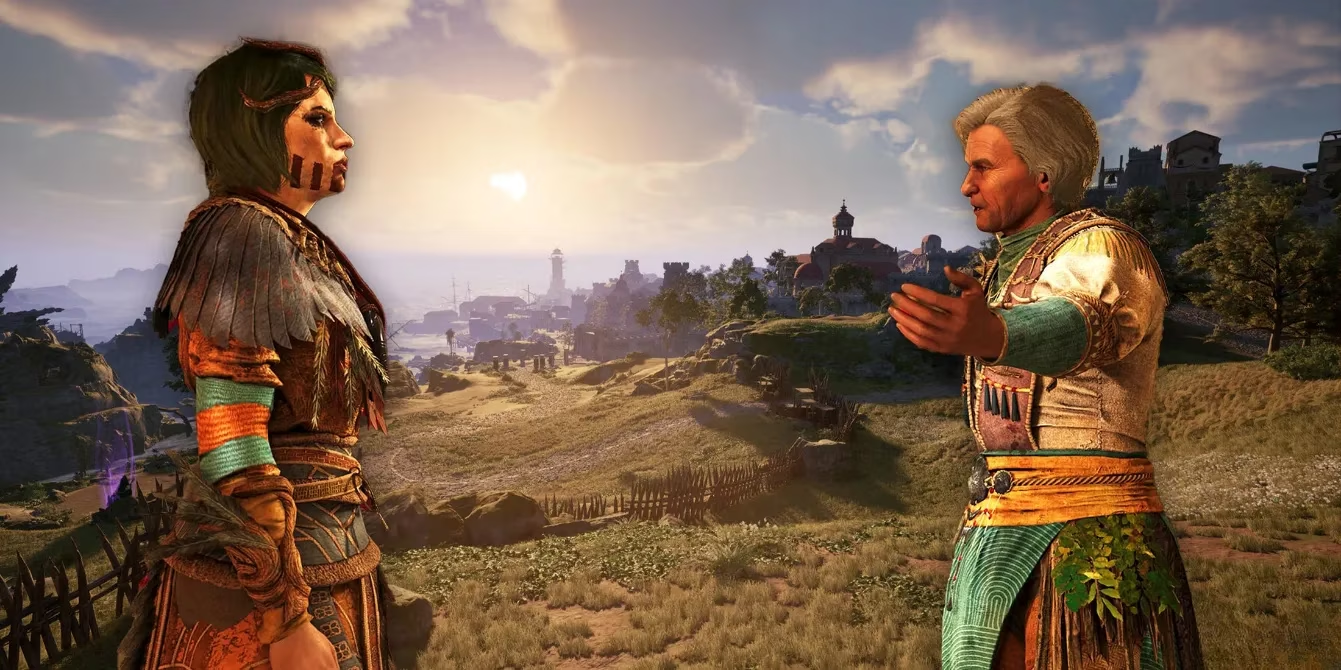
A Shared Visual Pulse
Let's be honest, the first thing that pulls us into a fantasy world is whether it looks like a place we want to actually live in (or at least survive in). Avowed and GreedFall 2 share a similar visual heartbeat. Obsidian is taking us to the Living Lands of Eora, a place defined by bizarre, vibrant, and often luminous ecosystems. On the other side of the coin, GreedFall 2 drags us kicking and screaming to the Old Continent of Gacane, a landscape that is undeniably more subdued but dripping with that same dense, painterly atmosphere.
Both games favor a saturated palette that makes the wilderness feel like a character rather than a backdrop. It is a visual style that acts like a siren’s call, constantly luring you off the main road just to see what is behind the next ridge. Avowed leans into a more stylized, almost animated saturation, while GreedFall 2 aims for a moodier, realist texture, but the underlying desire to showcase a world worth getting lost in is a mirror image.
The Weight of Your Tongue
Where the parallel becomes impossible to ignore is in the role-playing mechanics. These games are not power fantasies where you just hit things until numbers go up; they are social simulators wrapped in dragon hide. In both Avowed and GreedFall 2, your tongue is a weapon with a higher DPS stat than any sword you will find. The core loop of both titles relies on player choice and morality.
In GreedFall 2, you are playing a native of Teer Fradee, ripped from your home and forced to navigate the political viper pit of the colonizers. The game builds extensively on the reputation system from the first title, meaning the choices you make ripple outward, changing how entire factions view you. It is a complex web where helping one person almost always means slighting another.
Avowed, while distinctly more action-oriented in its moment-to-moment combat, borrows heavily from Obsidian’s legacy of narrative reactivity. You are not just deciding which spell to cast; you are deciding which philosophy to uphold in a land that is actively reacting to your presence. Both games treat the narrative not as a static script, but as a living organism that mutates based on your input. It is a delicate balancing act, like trying to juggle glass orbs while sprinting downhill—one wrong conversational choice and the fragile trust you built with a faction shatters on the ground.
Companions: The Emotional Anchor
I am a sucker for a good party dynamic, and both titles understand that a hero is only as interesting as the people complaining about their choices around the campfire. Avowed and GreedFall 2 place a heavy emphasis on companion relationships.
These are not just pack mules carrying your extra loot. In GreedFall 2, your companions have their own agendas, and they will not hesitate to call you out if your actions conflict with their values. If you are playing a manipulative character, don't expect the morally upright warrior to keep watching your back. Similarly, Avowed has been designed to ensure that your companions feel embedded in the world. They have opinions on the Living Lands, the politics of Eora, and the specific way you handle the colonial tensions present in the narrative.
It creates a rewarding feedback loop: you choose how to behave, you see that behavior reflected in the eyes of your allies, and you are forced to live with the consequences. It is a mechanic that makes the world feel less like a sandbox and more like a living, breathing community that is judging you—in the best possible way.
The Call of the Unmarked Path
For a fantasy world to work, exploration has to be its own reward. If you are not curious about what is over the horizon, the lore falls flat. Both GreedFall 2 and Avowed understand this implicitly. GreedFall 2 has been expanding its early access footprint, aiming to offer a more sprawling, interconnected map than its predecessor. The exploration is methodical; you are often rewarded for pausing to take in the environment, finding hidden paths or overlooked loot that ties back into the world-building.
Avowed is cut from a similar cloth, designed specifically to validate the player who refuses to walk in a straight line. Obsidian has littered the Living Lands with environmental storytelling and verticality. In both games, if you see a weird rock formation or a suspicious-looking cave, there is almost certainly something there for you. It is a design philosophy that turns curiosity into currency.
A Shared Legacy in 2026
Looking back from 2026, it is clear that GreedFall 2 and Avowed serve as two sides of the same golden coin. While Avowed has since established itself with its flashier combat and larger budget, GreedFall 2 continues to hold its own as a scrappier, deeply ambitious RPG from a smaller studio. If you are currently bouncing between these two titles, I envy you. You get to experience two beautifully flawed, richly designed worlds that understand the fundamental truth of great RPGs: the world should react to the player, not the other way around. They are both engines for emergent storytelling, ready to take you on a journey that is uniquely yours. 🎮✨