In the rich tapestry of fantasy narratives, the grand, world-ending antagonist often takes the form of dragons, ancient gods, or monstrous abominations. However, some of the most compelling and enduring threats are those woven from the very fabric of society itself—complex, systemic, and chillingly familiar. Obsidian Entertainment's Avowed and the broader Pillars of Eternity universe masterfully explore this concept through the Aedyr Empire, a civilization that functions not as a simplistic evil overlord, but as a sprawling, ancient power whose legacy is a tapestry of ambition, duty, and profound moral ambiguity. As players step into the role of an imperial envoy dispatched to the mysterious Living Lands in 2026, they are tasked with investigating the supernatural Dreamscourge plague, only to find themselves increasingly entangled in questions about the true nature of the homeland they serve.
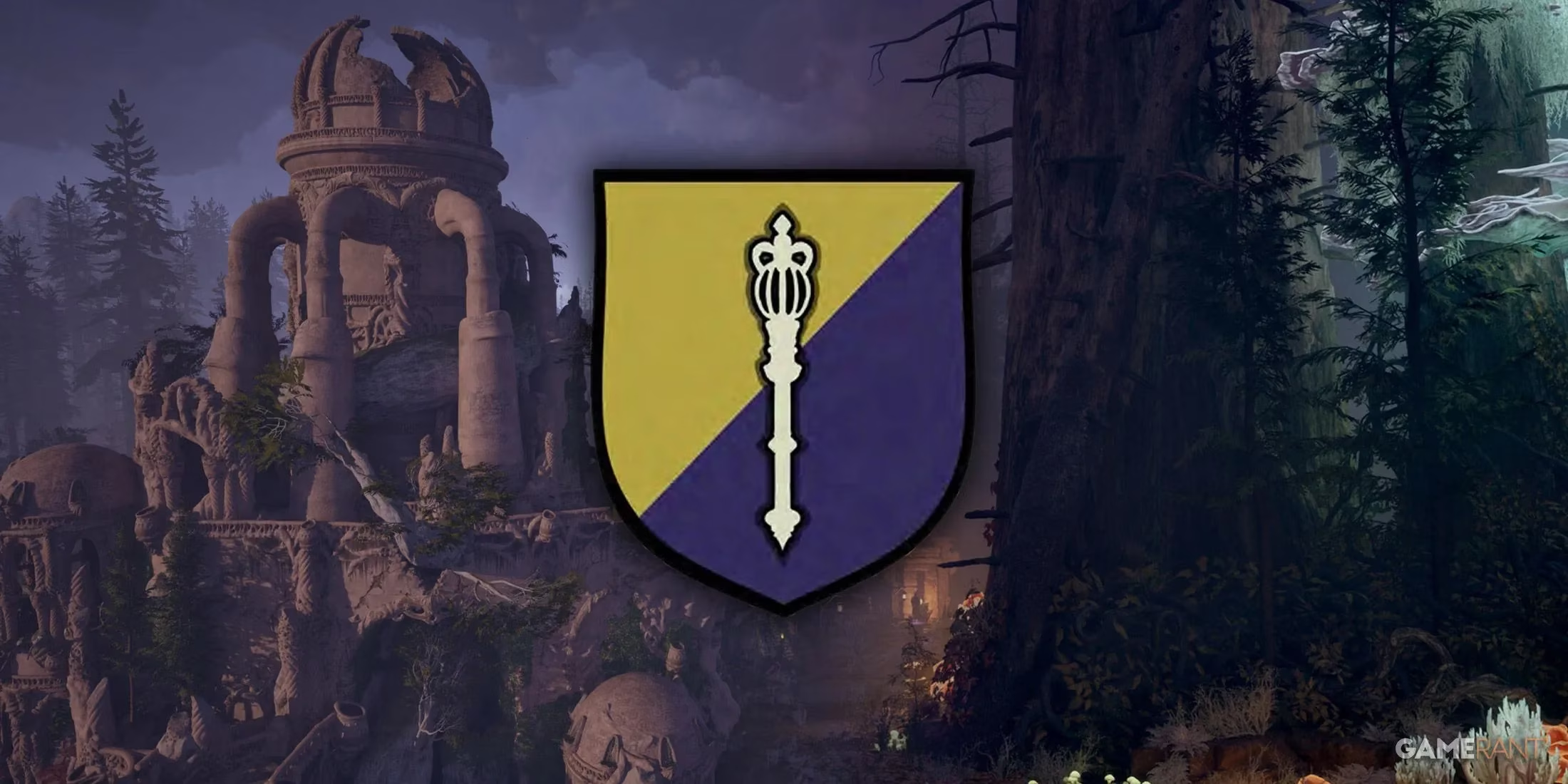
Foundations in Fire and Alliance
The roots of the Aedyr Empire stretch back over two millennia to 300 AI, beginning not with grand sorcery, but with the humble existence of deer-herding tribes. Their destiny was irrevocably altered upon contact with the Kingdom of Kulkin, an elven nation possessing superior technology and knowledge. A pact was forged: military aid from the Aedyr in exchange for Kulkin's tutelage. This symbiotic relationship, however, proved fragile. Wars between elves and humans erupted, scattering the Aedyr tribes until a unifying king emerged, consolidating them into a single kingdom. Through centuries of intermittent conflict and expansion, a pivotal shift occurred. Rather than perpetuate endless war, the Kingdom of Aedyr and the Kingdom of Kulkin chose a path of unprecedented union, laying down their arms to merge into the singular Aedyr Empire. This foundational act of alliance over annihilation set the stage for a civilization that would dominate its continent and beyond.
The Pillars of Aedyran Society
The empire's longevity and power are underpinned by core societal tenets that are as rigid as they are revered. These principles form the bedrock of Aedyran identity and its outward expansion.
-
Duty and Hierarchy: In Aedyr, duty is not merely an expectation; it is the cornerstone of societal prosperity. A strong sense of purpose is cultivated in every citizen, inextricably linked to an unwavering loyalty to family, friends, and the empire's strict political hierarchy. This creates a society that is highly organized and efficient, yet one where individual dissent is often subsumed by collective obligation. The empire operates like a vast, meticulously crafted clockwork mechanism, where every gear, from peasant to monarch, is expected to turn in flawless synchrony for the greater whole.
-
Divine Mandate: The spiritual life of the empire is dominated by the worship of Woedica, the goddess of law and vengeance. Believed to hold a special affection for Aedyr, Woedica is seen as granting divine protection to its monarchy. This intertwining of faith and statecraft provides a sacrosanct justification for the empire's laws and its expansionist endeavors. To oppose the empire's rulers is framed not just as treason, but as an act of blasphemy.
-
Fear of the Unnatural: Aedyr's relationship with progress is fraught with tension. It was within its borders that some of the earliest—and most catastrophic—experiments in Animancy (the science of soul energy) took place. Researchers successfully transferred a living soul into a dead body, an achievement that accidentally created the first documented undead. The backlash was swift and severe; Animancy was banned across the empire. To this day, many Aedyrans view the practice with deep suspicion, considering it a blasphemous perversion of the natural order, a ghost in the machine of the soul that must never be awakened again.
The Empire's Shadow: Ambiguity and Enforcement
While not inherently evil, the Aedyr Empire provides fertile ground for institutionalized darkness to flourish. Its immense structure casts long shadows where unsavory elements operate with varying degrees of official sanction.
| Organization | Primary Allegiance | Function & Method | Moral Ambiguity |
|---|---|---|---|
| The Steel Garrote | Woedica / Aedyr Empire | An order of paladins that hunts "oath-breakers." | Extremely High. Their vague mandate allows them to target anyone deemed unfaithful by the ruling class, bypassing conventional courts. |
| Imperial Colonial Authority | The Aedyran Crown | Manages and enforces control over foreign colonies like the Living Lands. | High. Pursuit of imperial interests often overrides local well-being and autonomy. |
| Traditionalist Clergy | Woedica | Upholds orthodox religious doctrine and opposes "unnatural" practices like Animancy. | Moderate to High. Can fuel intolerance and suppress scientific/arcane inquiry. |
Chief among these is The Steel Garrote, an order of paladins fanatically devoted to Woedica. Founded within the empire, they operate as a zealous enforcement arm, specializing in hunting down those accused of breaking oaths or promises. The deliberate vagueness of this mission statement is its most powerful—and terrifying—feature. It acts as a semantic net, capable of ensnaring anyone the Aedyran power structure wishes to silence, regardless of legal guilt or innocence. The Steel Garrote transforms the concept of justice into a tool of political control, a silent, creeping ivy that uses the walls of law and faith to strangle dissent.
A Legacy of Expansion and Control
By the time of Avowed's events, the Aedyr Empire's influence is a sprawling, multi-continental force. Its presence in the Living Lands is a direct extension of this imperial tradition. The envoy's mission, while framed as a humanitarian investigation into the Dreamscourge, is inherently an act of imperial oversight and intervention. Players exploring the frontier are constantly confronted with the evidence of Aedyr's reach:
-
Colonial Dynamics: The tension between imperial agents and local populations, indigenous cultures, and settlers.
-
Cultural Export: The pervasive spread of Aedyran customs, the worship of Woedica, and the societal emphasis on duty.
-
Hidden Agendas: The possibility that the empire's interest in the Living Lands and the Dreamscourge extends beyond mere plague control to encompass resource acquisition, strategic advantage, or the containment of dangerous knowledge.
This context forces a continuous, personal reckoning. The empire is not a distant, mustache-twirling villain, but the player-character's own origin point—a civilization that provided their identity, purpose, and authority. Uncovering its flaws, its brutal enforcement mechanisms, and the hidden costs of its prosperity is akin to an archaeologist carefully brushing sand from a magnificent, ancient mosaic, only to find the tiles are stained with a history that is both glorious and grim. The ultimate question Avowed poses is not whether the player can defeat a monster, but how they will reconcile their duty to an empire that may, in its relentless pursuit of order and growth, have become the very existential threat it claims to fight against.