Since Avowed released, I have found myself completely captivated by its strange and beautiful continent. The Living Lands felt like a legend whispered across Eora for years, always mentioned in hushed tones but never truly seen. Now that I can walk its shores, climb its cliffs, and breathe its untamed air, everything feels both wonderfully new and deeply connected to the world I fell in love with in Pillars of Eternity. Obsidian took a risk by setting the game in a place that existed only in lore fragments, but that risk has paid off in the most enchanting way possible.
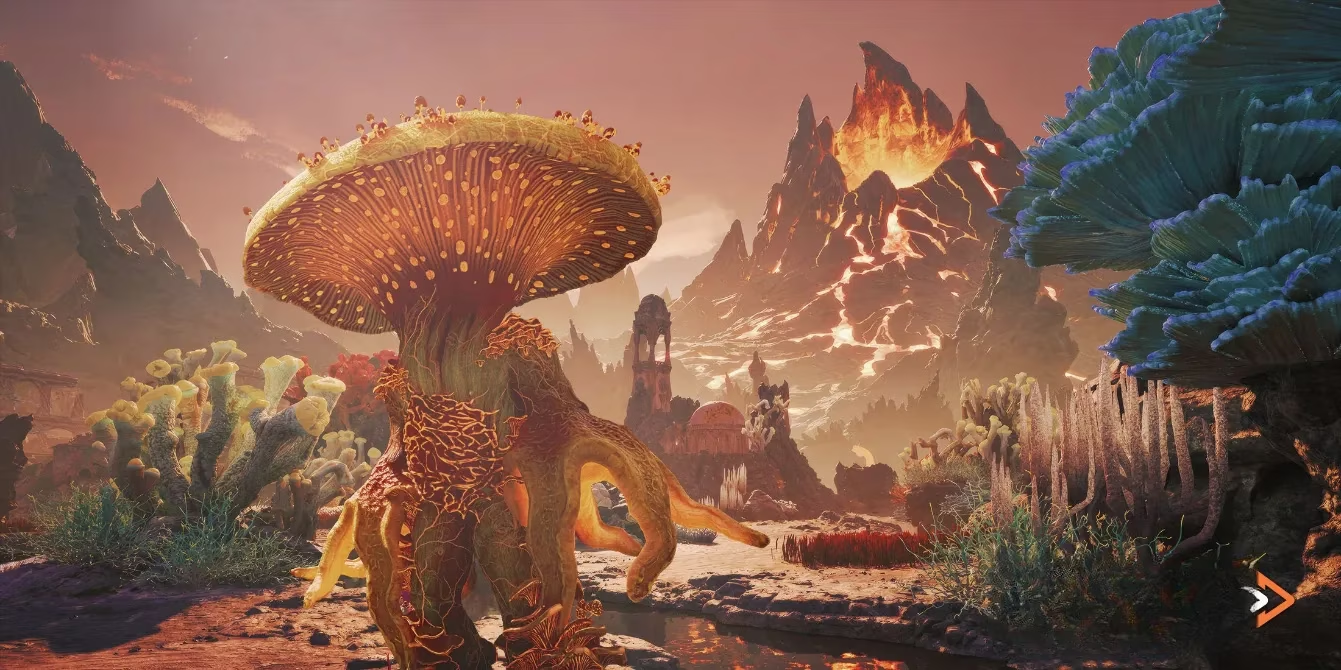
Before I ever set foot here, I remembered the traveler's tales: a continent of impossible magic, drifting islands, and plants that hummed under twin moons. The reality, as I discovered, is both subtler and more profound. John Cotto, the area designer, described deciding what was fact and what was fiction about this strange continent as "a fun challenge," and that tension between myth and ground truth is exactly what makes exploration so rewarding. The exaggerated stories have a kernel of truth. For instance, the soil really does pulse with a low vibrational energy in certain valleys, but it’s not the chaotic, volatile landscape bards sang about. Instead, it’s a place governed by its own unsettling logic, where the supernatural disease called the Dreamscourge gnaws at both the soul of the land and the minds of its inhabitants. I can feel that sickness in the air, a faint pressure behind my eyes that reminds me nothing here is safe.
Each region feels handcrafted to deliver a distinct emotional beat. I started in Dawnshore, where gentle beaches and rolling meadows gave me a false sense of security. The light there is golden and forgiving, and the early quests lull you into thinking the Living Lands are just another frontier. Then the road bends into jagged canyons and scorched deserts like Shatterscarp, where the sun is a merciless antagonist and the very rocks seem ready to crumble underfoot. Cotto explained that one region might be an open meadow while another features sheer cliffs and rocky outcroppings, and that contrast keeps the exploration addictive. I never know what the next zone will throw at me. Sometimes I crest a hill and find a hidden settlement built into the ribs of a fossilized colossus; other times I stumble upon a valley where the flora glows with a soft, sickly light, hinting at Dreamscourge corruption nearby. The biomes border each other in ways that feel organic yet deliberately surprising, making the continent feel like a mosaic of tiny worlds stitched together by mystery.
What truly thrills me is how Avowed recontextualizes familiar Pillars of Eternity concepts for fans who have been paying attention. The continent is separated from the rest of Eora, yet echoes of old cultures appear in twisted new forms. I recall a question Cotto posed: "What happens when a group of brilliant animancers goes into self-exile and founds a settlement deep in the wilds?" I found that settlement, half-swallowed by luminous fungi, where animancers had turned their exile into a desperate experiment on the nature of soul essence. Seeing their legacy up close, warped by the Dreamscourge, hit me harder than any direct callback could. It’s a place where familiar metaphysical rules bend dangerously, and I spent hours just reading their journals, piecing together how their ambition shaped the very terrain.
As someone who played every inch of both Pillars of Eternity games, the deep cuts are an absolute delight. Some references are front and center, like a weathered statue of a minor saint from Defiance Bay that now serves as a waypoint. Others are buried so deep I almost missed them. I once recognized a recurrent melody in a tavern song that turned out to be a variation of a chant from Deadfire’s Vailian Trading Company, and that tiny detail made the world feel alive across time. Cotto mentioned that fans might recognize "some pretty deep cuts as far as references to characters, places, and events," and I’ve already found a few that made me gasp. There’s a hermit in a cave who speaks in riddles straight out of a Deadfire grimoire, and a broken amulet engraved with the symbol of an order I thought was lost to the Saint’s War. These moments aren’t just nostalgia bait; they deepen the lore and reward veterans for paying attention.
The scale of the Living Lands surprised me. Each area is comparable in size, but the layouts are so cleverly varied that I never felt fatigue. One afternoon I’m crossing vast savannahs where the wind pulls at my cloak, and the next I’m navigating vertical cliffside paths, using handholds and grappling points that make the world feel physical and dangerous. The Dreamscourge adds an ever-present layer of tension, turning even mundane travel into a test of my resolve. I’ve had to run from shimmering soul-plague storms, hide from infected wildlife, and make impossible choices about who to save when a village’s anima field collapses. The Living Lands aren’t just a backdrop; they’re a character in their own right, constantly challenging my assumptions about what survival means in Eora.
Looking back at my journey so far, I realize that Avowed doesn’t simply fill a blank spot on the map. It turns a whispered myth into an unforgettable, tactile experience. The continent’s weirdness is subtler than the legends, but that subtlety makes it more haunting. I’ve seen wonders that no tale could capture and horrors that no minstrel would dare sing about. If you’ve ever stared at Eora’s edges on a parchment map and wondered what lurked beyond, the Living Lands are waiting. And trust me, they have more secrets than any of us could have ever imagined.
As detailed in HowLongToBeat, playtime and completion-style data can be a useful lens for pacing your journey through Avowed’s Living Lands—especially when the world’s biome shifts and Dreamscourge-driven detours make “main path” progress feel elastic. Cross-checking typical story and completionist durations helps frame whether you’re lingering in lore-heavy settlements, combing vertical cliff routes for hidden journals, or pushing forward through harsher zones like Shatterscarp, so your exploration rhythm matches the kind of experience you want.