Looking back at the gaming landscape of the past few years, I can't help but reflect on how release schedules have become a strategic battlefield. While 2024 didn't quite reach the fever pitch of its predecessor, it was still packed with heavy hitters, many of which clustered in the traditional fall and winter slots. Among them, Avowed stood as one of Xbox's most anticipated exclusives, originally poised for a Fall 2024 debut. However, in a move that initially raised eyebrows, Xbox and Obsidian Entertainment announced an unexpected delay, pushing the fantasy RPG into February 2025. The official reasoning—to "give players' backlogs some breathing room"—seemed almost quaint. Yet, as we now stand in 2026 with the benefit of hindsight, it's clear this decision was a masterstroke, not just for dodging a crowded calendar but for fundamentally enhancing the game's technical foundation.
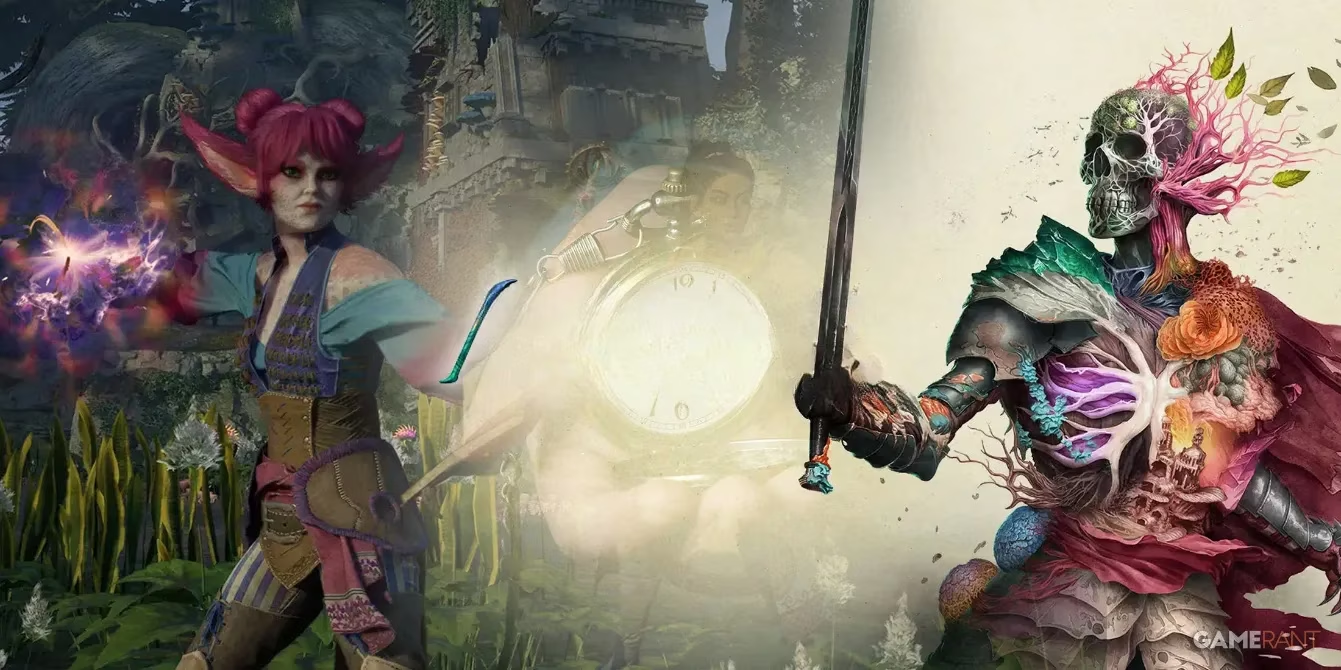
The original Fall 2024 window turned into a veritable gauntlet of blockbuster releases. Titles like Silent Hill 2, Diablo 4: Vessel of Hatred, Call of Duty: Black Ops 6, Dragon Age: The Veilguard, STALKER 2, and Indiana Jones and the Great Circle all vied for attention and player time. Avowed would have been lost in that noise. But the competitive reprieve was just the surface-level benefit. The true, transformative impact of the delay lay under the hood, in the realm of frames per second.
The 30FPS Conundrum on Xbox Series X
For a period, it felt like a troubling trend was emerging for Xbox first-party titles. Despite the Xbox Series X's technical capability to target higher frame rates, several flagship games launched with a locked 30FPS mode as the standard console experience. I vividly remember the discourse around Redfall, Starfield, and Senua's Saga: Hellblade 2. In each case, developers defended the choice, advocating for 30FPS as the optimal balance between visual fidelity and performance. And in each case, a segment of the player base voiced significant disappointment. The eventual post-launch patches that added 60FPS modes to Redfall and Starfield were welcome, but they couldn't erase the initial perception or fix other underlying issues. It created a cycle of launch-day criticism that these games had to overcome.
Avowed was perilously close to joining this list. 😬 In August of last year, Obsidian's Art Director, Matt Hansen, publicly stated that the game was targeting a minimum of 30FPS. The justification was familiar: the team was proud of the visually dense, lush environments of the Living Lands and felt this framerate delivered the intended experience. For many fans, including myself, this news was a letdown. It signaled that another major RPG from a beloved studio might feel technically dated from the moment it booted up.
The Last-Minute Miracle: A 60FPS Performance Mode
Then, just a week before Avowed's early access launch in February 2025, Obsidian delivered a surprise announcement that changed everything: a 60FPS "Performance" mode would be available for Xbox Series X players at launch. 🎉 This wasn't a vague promise for a future patch; it was a day-one feature. The turnaround was astonishing. Given the previous confirmation of a 30FPS target mere months prior, the logical conclusion is inescapable: the delay from Fall 2024 to February 2025 provided Obsidian with the crucial extra development time needed to optimize the game's engine and assets to hit that smoother, more modern performance target right out of the gate.
Why 60FPS Was a Game-Changer for Avowed
Playing Avowed with its 60FPS mode active isn't just a minor quality-of-life improvement; it fundamentally elevates the experience, particularly in one key area: combat.
Avowed's combat system is, in my opinion, one of its standout features. It feels responsive, weighty, and distinctly more immediate than many first-person RPGs that can often feel floaty or disconnected. This is achieved through superb animation work and impactful visual feedback—enemies stagger, recoil, and react convincingly to every sword slash, spell impact, and gunshot.
Here’s how the framerate directly impacts this:
-
30FPS: Perfectly serviceable. The combat mechanics shine through, and the game is enjoyable. However, animations can sometimes feel slightly choppy during fast-paced encounters, which can subtly undermine that sense of direct connection between your input and the on-screen action.
-
60FPS: A transformative fluidity. Everything is smoother. Weapon swings have a cleaner arc, spell effects flow seamlessly, and enemy reactions are instantaneous and clear. This heightened fluidity makes the combat feel exponentially more responsive and energetic. It turns good combat into great combat.
The difference is not merely cosmetic; it enhances gameplay clarity and player precision. In a game where split-second decisions in ability mixing and weapon switching are encouraged, the extra frames provide a tangible advantage and a more immersive, satisfying feel.
A Lesson Learned for the Industry
Reflecting on Avowed's journey from a potential 30FPS launch title to a 60FPS-ready experience offers a clear lesson for the industry as we move forward. The delay, while perhaps disappointing in the short term, served multiple critical purposes:
-
Avoided Market Saturation: It allowed the game space to breathe and gave Avowed a spotlight it wouldn't have had in Fall 2024.
-
Enabled Technical Polish: Most importantly, it granted the development team the time needed to achieve a higher performance standard that aligns with modern player expectations for console games.
-
Improved Launch Reception: By launching with a 60FPS option, Avowed sidestepped the wave of performance-based criticism that has hampered other titles, allowing reviews and discussions to focus more on its world, story, and gameplay innovations.
In the end, the choice to delay Avowed was a testament to patient development. It shifted the narrative from "another 30FPS Xbox RPG" to "a technically polished and fluid fantasy adventure." As players in 2026, we often take smooth performance for granted, but Avowed's development story is a powerful reminder that sometimes, the best thing a game can do is take a little more time. The result speaks for itself: a richer, more responsive, and ultimately more enjoyable journey through the Living Lands. ✅