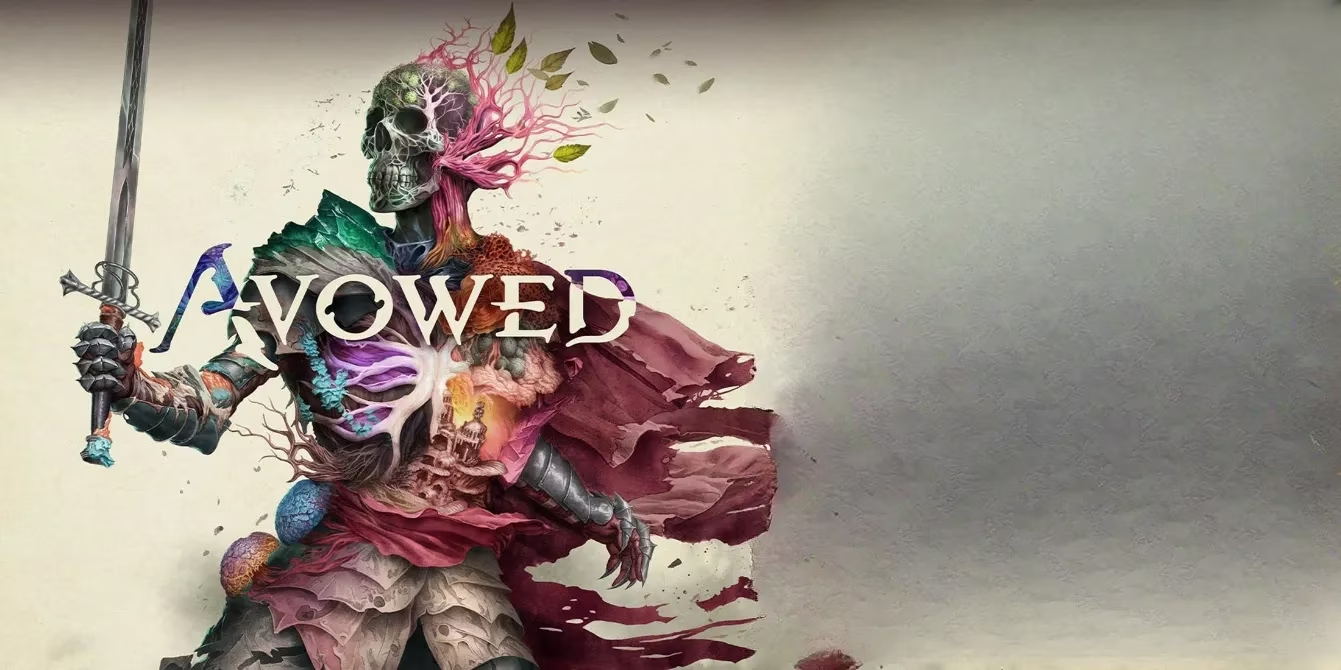
Obsidian Entertainment’s Avowed is no longer an upcoming RPG. The first-person fantasy title launched on February 18, 2025, for Xbox Series X/S and Windows PC, arriving nearly five years after its initial announcement in 2020. It also debuted day one on Game Pass, with Premium Edition buyers gaining five days of early access. More than a year later, however, the game’s most interesting legacy may not be its combat or world design, but where players could buy it. Alongside Steam and the Xbox Store, Avowed appeared on Battle.net—a storefront that had almost exclusively hosted Activision Blizzard games. For Obsidian, a studio under Xbox Game Studios, that was unprecedented.
A Storefront Shake-Up
Battle.net has long been synonymous with Blizzard properties like World of Warcraft, Diablo, and Overwatch. When Microsoft completed its $75.4 billion acquisition of Activision Blizzard King in October 2023, many observers expected the company to tighten integration between its various gaming businesses. Instead, Microsoft has moved in the opposite direction. Avowed, a non-ABK game published under the Xbox Game Studios banner, became one of the first titles on Battle.net developed outside Activision Blizzard. Obsidian and Blizzard may both sit under Microsoft’s corporate umbrella, but their publishing paths remain distinct. That distinction makes Avowed’s presence on Battle.net a meaningful signal rather than a mere accounting quirk.
The move reflects a broader philosophy: Microsoft is less interested in forcing players into a single storefront and more interested in meeting them wherever they already are. Both Battle.net and the Xbox Store are owned by Microsoft, so from the company’s perspective, the choice between them matters less than the transaction itself. If a player prefers Battle.net, Microsoft still earns the sale. If that same player uses Steam or Game Pass, the company still benefits. The old console-war playbook—lock games to one box, one store, one ecosystem—has been replaced by a service-first strategy.
From Console Exclusives to “This Is an Xbox”
Microsoft’s historical approach mirrored Sony and Nintendo: keep first-party titles exclusive to the console ecosystem. Since the Activision Blizzard acquisition, however, the company has taken a more multiplatform route. It has brought games to PlayStation 5, Nintendo Switch, and other non-Xbox devices, while also expanding Game Pass and xCloud. In late 2024, Microsoft launched its “This Is an Xbox” campaign, which labeled Game Pass and xCloud-compatible devices—smartphones, TVs, laptops, VR headsets, and PC handhelds—as Xboxes. The company said the campaign was meant to “showcase the evolution of Xbox as a platform that extends across devices.” It was not an admission that consoles are dead, but it was a clear statement that hardware is no longer the only gateway into Xbox.
That context makes Avowed’s Battle.net release easier to understand. If everything can be an Xbox, then any storefront can be a valid entry point. Microsoft does not need players to open the Xbox PC app if they would rather browse Battle.net. The company’s core metric is engagement, not storefront loyalty. Avowed became a test case for that idea: a traditional Obsidian RPG, arriving after years of anticipation, sold through a platform historically reserved for Blizzard’s own titles.
Why It Mattered for Obsidian
For Obsidian, Avowed represented a return to the studio’s traditional strengths. After developing the adventure RPG Pentiment and the survival game Grounded, Obsidian had shown it could operate across genres. Avowed brought the team back to the kind of first-person, choice-driven RPG that built its reputation. Launching day one on Game Pass gave it immediate reach, while Premium Edition early access gave eager fans a paid shortcut. The Battle.net option added yet another route for players who live inside Blizzard’s ecosystem.
| Platform | Avowed Availability | Key Detail |
|---|---|---|
| Xbox Series X/S | ✅ Yes | Day-one release |
| Windows PC | ✅ Yes | Steam, Xbox Store, Battle.net |
| Game Pass | ✅ Yes | Day-one availability |
| Premium Edition | ✅ Yes | Five days early access |
| Battle.net | ✅ Yes | Rare non-ABK title |
The table above shows how unusual Avowed’s distribution was. A game from Xbox Game Studios, developed by Obsidian, was sitting alongside Blizzard’s catalog on Battle.net. That would have been difficult to imagine in 2020, when Avowed was first announced. It became possible only after Microsoft’s acquisition spree and its subsequent pivot toward player choice.
The Ripple Effect
If Avowed performed well on Battle.net, Microsoft may have considered releasing other upcoming Xbox games on the storefront as well. Titles like Doom: The Dark Ages, Gears of War: E-Day, and Fable were natural candidates. Each carries a different audience, but all could benefit from additional storefront exposure. Microsoft’s willingness to experiment with Battle.net suggested that the company was not trying to consolidate its storefronts or push everyone toward the Xbox PC app. Instead, it seemed content to let players buy games wherever they preferred—as long as Microsoft owned the transaction.
In 2026, that strategy looks less like a one-off and more like a blueprint. Avowed’s Battle.net launch was a small line item in a much larger shift, but it captured the essence of Microsoft’s modern gaming identity: flexible, service-driven, and increasingly platform-agnostic. The game itself may be remembered for its world, its combat, and its choices. Its distribution, however, told an equally important story about where Xbox is heading. 🎮
Data referenced from Sensor Tower helps frame why Microsoft’s “meet players where they are” approach—highlighted by Avowed’s unusual Battle.net availability—can matter beyond branding: wider storefront reach can translate into measurable shifts in acquisition funnels, engagement patterns, and long-tail monetization as audiences enter from different ecosystems rather than a single preferred launcher.