For the dedicated roleplayer, the promise of a true blank slate is as elusive as a dragon in downtown Manhattan. Too often, modern RPGs funnel you down a pre-determined narrative chute, your so-called 'choices' feeling more like selecting different flavors of the same corporate smoothie. Avowed, however, feels different. It’s a game that doesn't just hand you a character sheet; it hands you a lump of narrative clay and says, 'Go on, get your hands dirty.' The joy isn't just in reaching one of its multiple endings, but in the meandering, personality-driven journey to get there, a journey you'll likely want to take multiple times just to see how a different version of 'you' would navigate the Living Lands.
Your Background Isn't Just Flavor Text; It's Your Narrative Skeleton
In many contemporary RPGs, selecting a background is like choosing a wallpaper for a room you'll barely spend time in—aesthetic but functionally inert. In Avowed, your chosen origin story is more than a footnote; it’s the operating system for your character's dialogue and worldview. It’s the difference between a character who feels like a cardboard cutout and one who feels like they have a spine made of their own personal history. The game treats your background not as a starting stat bonus to be forgotten, but as a persistent lens through which you experience the world.
For instance, playing as a Court Augur—an unsettling mystic with powers of foresight—fundamentally changes conversational dynamics. You’re not just a generic hero; you’re someone who might speak in riddles, see glimpses of futures untold, or view mortal struggles with a detached, cosmic melancholy. This background provides specific, unique dialogue options that do the narrative heavy lifting, allowing you to craft a character who is aloof, dreamy, and a little too fascinated with their own navel, yet still capable of empathy. Other backgrounds, like the grizzled Soldier or the cunning Scholar, aren't just cosmetic swaps; they offer entirely different rhetorical toolkits and perspectives, making subsequent playthroughs feel less like a rerun and more like watching a different director's cut of the same epic film.
Conversations Without a Safety Net: The Freedom to Be a Jerk
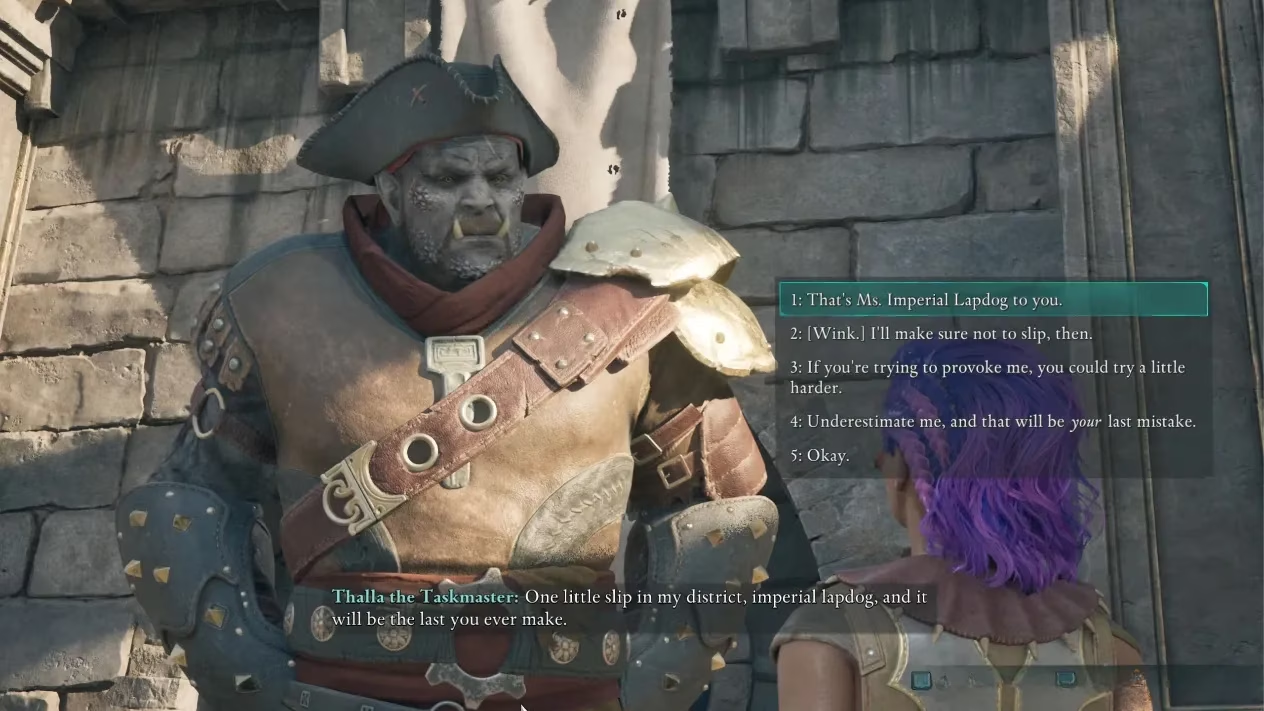
Where Avowed truly shines is in its commitment to conversational authenticity. This isn't a game that holds your hand or paints the 'optimal' dialogue choice in neon green. There are no 'Paragon' or 'Renegade' prompts telegraphing the moral weight of your words. Instead, you're thrown into the conversational deep end with a toolbox full of personality traits, some of them decidedly sharp and pointy. The freedom to be a sarcastic, cruel, or apathetic jerk isn't just an afterthought; it's a fully supported playstyle, complete with Achievements for lying your way through a situation or resorting to violence via dialogue.
This approach is as refreshing as finding an ice-cold health potion in a desert. You can't exhaust every dialogue option in a single conversation, forcing you to make meaningful choices about what your character would actually say, not what yields the best loot. Skill-checked dialogue options don't guarantee success; they simply represent your character attempting something based on their prowess, with failure often leading to more interesting, organic outcomes than a sterile 'success' ever could. The game actively discourages metagaming. You might fail a quest because you chose a dialogue option that felt true to your character, not because you picked the 'wrong' one. In Avowed, a conversation is a living thing, not a multiple-choice test to be gamed—it’s less like navigating a flowchart and more like conducting an orchestra where you don’t know what instrument you’ll be handed next.
The Joy of Imperfect Roleplay: Escaping the Metagaming Prison
Perhaps the most liberating aspect of Avowed is its embrace of the imperfect, character-driven moment. It understands that true roleplaying isn't about optimizing for the 'best' story outcome, but about committing to a persona and riding the waves of consequence, however small. The game’s world doesn't react with seismic shifts to every snarky comment, which paradoxically makes your choices feel more personal and less like you're constantly steering the Titanic. Most conversations will reach a similar narrative destination, but the journey—the tone, the relationships, the little victories and humiliations—is entirely your own.
This design philosophy feels like a defiant stand against the homogenization of player agency. In Avowed, you are finally free from the shackles of save-scumming every conversation to find the 'perfect' response. You can inhabit your Envoy like a well-worn coat, making choices not based on a hidden point system, but on a simple question: 'What would this weirdo do?' It creates a play space where you can experiment with personalities as freely as a child mixes potions in the backyard, without the fear of blowing up the whole neighborhood. It’s a return to the genre's roots, where roleplaying was about being someone else for a while, not about collecting the most optimal ending slides. In a landscape crowded with RPGs that promise the world, Avowed delivers something rarer: a genuine character-driven sandbox where your imagination, not a quest marker, is the true guide.